


CREM & FM
Create a single source of truth for all information related to your buildings, assets, spaces, services, and energy data.
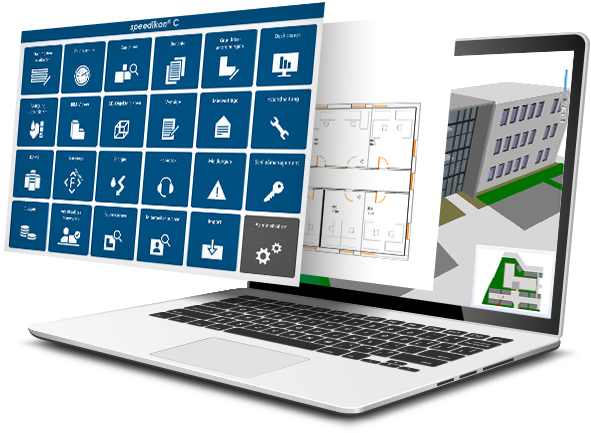
With speedikon® C, you connect data, processes, and teams on one platform—creating the foundation for greater transparency, more efficient operations, and informed decision-making across your organization. From day-to-day facility operations to long-term portfolio strategy, everyone works from the same trusted data foundation.
Everything Your Real Estate
and Asset Operations Need
Corporate Real Estate and Facility Management are not defined by a single process. They encompass spaces, assets, services, energy, costs, contracts, service requests, cleaning operations, workplace management, relocations, and much more.
speedikon® C brings all of these disciplines together within one integrated software environment. The solution is complemented by powerful energy and resource data management capabilities, creating a unified data foundation for every team working with buildings, assets, and locations.
The modules cover all core infrastructural, commercial, and technical workflows—from space management, workplaces, and cleaning services to contracts, budgets, service charge accounting, maintenance, energy management, and ticketing processes.

Spend Less Time Searching. Gain More Insight. Make Better Decisions.
With speedikon® C, you no longer work with scattered spreadsheets, disconnected tools, and incomplete information. Instead, you establish a central foundation where technical, infrastructural, and commercial data come together—giving every stakeholder access to the information they need to act with confidence.
Get Started Today!
Explore Our Modules
Infrastructure Facility Management Processes

From strategic space planning to key management, infrastructure FM processes provide the foundation for efficient buildings, optimized space utilization, and seamless operations across your entire portfolio.
- Strategic Space Planning
- Space Management
- Workplace Management
- Cleaning Management
- Outdoor Space Management
- Land Parcel Management
- Key Management
- Key Confirmation
- Visitor Registration
- Scenario Planning
Strategic space planning creates a reliable foundation for decisions about your future space requirements.
Buildings, rooms, space types, organizational units, and occupancy data are connected in a way that allows you to see not only what space exists, but how it is being used and where opportunities for optimization lie.
This enables data-driven planning for relocations, densification initiatives, repurposing projects, and site development scenarios. For large organizations in particular, it provides a transparent basis for space strategies and long-term portfolio planning.
Space Management is one of the core pillars of speedikon® C.
Buildings, floors, rooms, space categories, occupancy types, and organizational structures are managed in a structured environment and can be analyzed both graphically and alphanumerically.
As a result, your space data becomes more than documentation—it becomes an operational asset. The same data foundation supports cost allocation, cleaning management, workplace administration, relocations, lease management, and strategic space planning.
At any time, you can understand which spaces exist, who occupies them, and how they evolve over time.
Workplace Management connects workplaces, employees, organizational units, and cost centers within a single operating model. Dedicated desks, flexible workplace concepts, and hybrid arrangements can be managed and analyzed transparently.
Especially in hybrid work environments, the module provides clarity:
- Who uses which space?
- Which workplaces are occupied?
- Which cost center is responsible?
- Where are capacity constraints or unused resources emerging?
By combining occupancy data, visual representations, and reporting capabilities, workplace utilization becomes visible, measurable, and manageable.
Cleaning Management uses existing building data to automatically structure cleaning areas, service scopes, frequencies, and service specifications.
Rooms, usage types, and space information become the foundation for a transparent and efficient cleaning operation.
Cleaning services can be documented, monitored, and evaluated directly within the platform. Whether managing service providers, ensuring quality standards, or supporting specialized environments such as cleanrooms, the module ensures that cleaning processes are no longer managed through disconnected spreadsheets, but are fully integrated with your building data.
Outdoor Space Management enables organizations to document and manage external areas with the same level of structure and transparency as indoor spaces.
This includes green spaces, pathways, traffic areas, parking facilities, courtyards, operational grounds, and other outdoor infrastructure.
As a result, outdoor areas become part of your central FM data foundation. Maintenance planning, safety compliance, service provider management, budgeting, and space analysis can all be managed using documented outdoor assets.
This is particularly valuable for industrial sites, campuses, healthcare facilities, public institutions, and large manufacturing environments.
Land Parcel Management connects cadastral and property information directly with your sites, buildings, and operational structures.
Land parcels, ownership information, land registry records, and related documentation can be centrally managed and viewed within the context of your real estate portfolio.
This creates a reliable foundation for site development, ownership verification, compliance requirements, planning activities, and portfolio decisions. Instead of managing property data in isolation, it becomes an integrated part of your overall building and location structure.
Key Management provides complete visibility into keys, doors, locking systems, rooms, access permissions, and responsibilities.
You can instantly see which keys exist, where they belong, and which individuals have access to specific rooms, buildings, or secured areas.
The result is greater transparency and control over security, access management, and operational responsibility. Particularly during relocations, organizational changes, audits, or key loss incidents, all permissions remain fully traceable and manageable.
Key Confirmation enables organizations to regularly verify key inventories through a structured digital process.
Key holders can be requested to confirm possession of assigned keys, ensuring that documented records remain accurate and up to date.
What was once a static record becomes a continuously validated dataset. Organizations can quickly identify missing confirmations, keys still in circulation, and areas requiring follow-up action—providing an important foundation for security, internal controls, and audits.
Visitor Registration digitizes reception and access processes.
Visitors, appointments, hosts, locations, and access information can be recorded in a structured and auditable manner.
The module supports professional reception workflows while providing complete transparency into who is present at which location and at what time. Particularly within industrial facilities, public institutions, research organizations, and security-sensitive environments, it creates a reliable and professional visitor management process.
Scenario Planning allows organizations to create, compare, and evaluate different planning alternatives directly within the system.
Whether optimizing space, preparing a relocation, managing renovations, or planning site development projects, alternative scenarios can be analyzed before decisions are implemented.
This enables stakeholders to understand the impact on space utilization, occupancy, organizational structures, and costs before committing resources. Decisions are no longer based on isolated drawings or spreadsheets but on transparent, data-driven scenarios built on your existing information foundation.
Commercial Facility Management Processes

Organizations that successfully manage real estate and assets require complete transparency into costs, contracts, and services at all times. Commercial FM processes create the foundation for informed decision-making, financial control, and sustainable business performance.
- Lifecycle Management
- Work Order Management
- Budget Planning
- Contract Management
- Lease Management
- Service Charge Accounting
- Inventory Management
Lifecycle Management enables organizations to evaluate buildings, assets, and spaces across their entire lifecycle.
Acquisition, operation, maintenance, modernization, replacement, renovation, and decommissioning activities can be assessed within a single strategic context.
This provides a reliable foundation for investment planning, value preservation, and long-term portfolio management. Conditions, actions, costs, and developments are no longer viewed as isolated events but as part of a continuous asset journey.
Work Order Management supports internal and external assignments from initial request through completion.
Responsibilities, statuses, communications, documentation, services, and results are managed centrally and remain fully transparent for all stakeholders.
Operational activities no longer need to be coordinated through emails, phone calls, or disconnected task lists. Work orders can be tracked, analyzed, and linked to maintenance activities, helpdesk requests, service provider management, and cost allocation processes.
Budget Planning enables organizations to build budgets using real building, asset, contract, project, and consumption data.
This creates a stronger foundation for investment decisions, maintenance planning, operational expenditure forecasting, and strategic initiatives.
The real value lies in connecting budget planning directly to your operational data. Planned measures, projected costs, priorities, and future developments remain transparent, traceable, and measurable throughout the planning process.
Contract Management provides centralized control over contracts, terms, deadlines, responsibilities, and contractual relationships linked directly to buildings, spaces, assets, service providers, and services.
Contracts become operational assets rather than static documents.
Organizations gain immediate visibility into which contracts belong to which assets, which deadlines require attention, what services have been agreed upon, and where action is needed.
Lease Management centrally manages leased spaces, lease agreements, contract terms, rental income, contractual information, and related billing data.
Lease relationships are connected directly to buildings, spaces, and portfolio structures.
This creates complete transparency into occupied space, revenue streams, critical deadlines, and contractual changes. Especially within large portfolios, complex leasing structures, and internal occupancy models, the module provides a reliable commercial data foundation.
Service Charge Accounting uses space, contract, consumption, and cost data to prepare allocations and settlements in a structured and transparent manner.
Costs can be assigned, distributed, and documented according to predefined business rules.
The result is reduced manual effort, improved accuracy, and greater transparency—particularly in environments with multiple tenants, departments, cost centers, or buildings.
By integrating directly with Space Management, Energy Management, and Lease Management, all calculations are based on a consistent and trusted data foundation.
Inventory Management enables organizations to track movable assets together with their location, ownership, condition, documentation, and master data.
Inventory is no longer maintained as a simple asset list. Instead, it becomes an integrated part of your building, space, and organizational structure.
You always know what assets exist, where they are located, who is responsible for them, and what condition they are in. This supports asset tracking, cost allocation, relocations, audits, and daily operational processes.
Technical Facility Management Processes

Technical Facility Management processes provide complete visibility into assets, conditions, incidents, and energy consumption. From maintenance and ticketing to warranty management and energy optimization, they help ensure the safe, efficient, and cost-effective operation of buildings and technical infrastructure.
- Helpdesk & Ticketing
- Maintenance Management
- Condition Management
- Building Services Manager
- Fleet Management
- Energy Management
- Warranty Management
- Data Center Management
Helpdesk & Ticketing creates a single point of entry for service requests, incidents, maintenance issues, and internal work orders.Users can submit requests easily, responsibilities are assigned automatically, processing status remains visible, and all communication is managed within a structured workflow.I ts greatest strength is flexibility. Service processes can be configured to match your organization’s unique requirements.
Whether it is a maintenance issue, procurement request, service order, event, relocation, or internal inquiry, individual requests become transparent and measurable workflows with clearly defined responsibilities, statuses, and reporting capabilities.
Maintenance Management supports the planning, execution, and documentation of inspections, preventive maintenance activities, repairs, incidents, and corrective measures across buildings, assets, and technical systems. Assets, tasks, schedules, documents, and responsibilities are managed within a single integrated process.
This creates a reliable foundation for operational compliance, asset availability, and technical performance. Maintenance activities are not simply completed and forgotten—they are documented, analyzed, and linked to asset histories, conditions, and related facility management processes, creating a complete picture of operational performance.
Condition Management enables organizations to assess, document, classify, and monitor the condition of buildings, building components, assets, and technical systems over time. Rather than reacting only when problems occur, organizations gain a proactive understanding of asset health and risk exposure. The module supports investment planning, renovation strategies, and maintenance prioritization by identifying where action is needed, what risks exist, and how asset conditions evolve throughout the portfolio lifecycle.
The Building Services Manager connects building systems and technical equipment with spaces, documentation, maintenance activities, incidents, and operational data. Technical assets are managed within their spatial and operational context rather than as isolated components.
This creates complete transparency into the technical structure of a building: Which asset belongs where? Which documents, maintenance activities, and incidents are associated with it? What dependencies exist? The result is improved operational efficiency, maintenance planning, documentation quality, and technical decision-making.
Fleet Management provides centralized control over vehicles, usage records, schedules, costs, documentation, and responsibilities. Vehicles can be assigned to locations, departments, organizational units, or cost centers and integrated into operational processes.
Organizations gain complete transparency into fleet availability, utilization, maintenance requirements, and operating costs. Especially within large enterprises, fleet management becomes part of a shared operational and financial data foundation instead of being maintained through disconnected spreadsheets and standalone systems.
Energy Management captures, processes, and analyzes energy and resource data from a wide range of sources. Metering points, sensors, consumption data, utility records, and time-series information are consolidated into a structured environment for monitoring, reporting, analysis, and optimization.
The module supports the entire energy management lifecycle—from data acquisition and monitoring to performance analysis and evaluation of energy efficiency measures. Energy and resource consumption can be analyzed in the context of buildings, assets, cost centers, or entire locations, creating a reliable foundation for operational efficiency, cost allocation, ESG reporting, and sustainability initiatives.
Warranty Management helps organizations maintain control over warranty periods, defects, claims, supporting documentation, and responsibilities. Warranty cases can be linked directly to buildings, assets, work orders, projects, documents, and corrective actions.
This ensures that organizations never lose track of important deadlines, outstanding claims, or critical documentation. Particularly for new construction projects, renovations, technical installations, and outsourced services, the module helps protect contractual rights while maintaining complete traceability throughout the warranty lifecycle.
Data Center Management supports the core operational processes required to manage critical infrastructure. This includes asset and cable management, IMAC processes, work orders, future resource management, performance monitoring, and energy management.
The module helps data center operators gain complete visibility into infrastructure, improve resource planning, and manage operational processes with confidence and precision.
Through integration with building management systems, ERP platforms, CMDBs, and operational technologies, Data Center Management becomes a seamless part of your existing IT and operational ecosystem. The result is greater operational resilience, improved efficiency, and stronger control over mission-critical infrastructure.